
Publications
Highlighted Publications
Plasma membrane abundance dictates phagocytic capacity and functional cross-talk in myeloid cells.
Winer BY, Settle AH, Yakimov AM, et al.
Professional phagocytes like neutrophils and macrophages tightly control what they consume, how much they consume, and when they move after cargo uptake. We show that plasma membrane abundance is a key arbiter of these cellular behaviors. Neutrophils and macrophages lacking the G protein subunit Gβ4 exhibited profound plasma membrane expansion, accompanied by marked reduction in plasma membrane tension. These biophysical changes promoted the phagocytosis of bacteria, fungus, apoptotic corpses, and cancer cells. We also found that Gβ4-deficient neutrophils are defective in the normal inhibition of migration following cargo uptake. Sphingolipid synthesis played a central role in these phenotypes by driving plasma membrane accumulation in cells lacking Gβ4. In Gβ4 knockout mice, neutrophils not only exhibited enhanced phagocytosis of inhaled fungal conidia in the lung but also increased trafficking of engulfed pathogens to other organs. Together, these results reveal an unexpected, biophysical control mechanism central to myeloid functional decision-making.
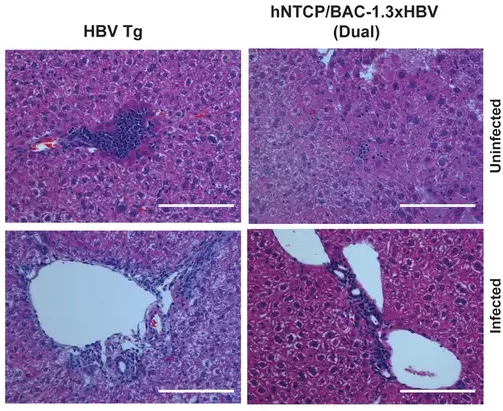
Preclinical assessment of antiviral combination therapy in a genetically humanized mouse model for hepatitis delta virus infection.
Winer BY, Shirvani-Dastgerdi E, Bram Y, et al.
Chronic delta hepatitis, caused by hepatitis delta virus (HDV), is the most severe form of viral hepatitis, affecting at least 20 million hepatitis B virus (HBV)-infected patients worldwide. HDV/HBV co- or superinfections are major drivers for hepatocarcinogenesis. Antiviral treatments exist only for HBV and can only suppress but not cure infection. Development of more effective therapies has been impeded by the scarcity of suitable small-animal models. We created a transgenic (tg) mouse model for HDV expressing the functional receptor for HBV and HDV, the human sodium taurocholate cotransporting peptide NTCP. Both HBV and HDV entered hepatocytes in these mice in a glycoprotein-dependent manner, but one or more postentry blocks prevented HBV replication. In contrast, HDV persistently infected hNTCP tg mice coexpressing the HBV envelope, consistent with HDV dependency on the HBV surface antigen (HBsAg) for packaging and spread. In immunocompromised mice lacking functional B, T, and natural killer cells, viremia lasted at least 80 days but resolved within 14 days in immunocompetent animals, demonstrating that lymphocytes are critical for controlling HDV infection. Although acute HDV infection did not cause overt liver damage in this model, cell-intrinsic and cellular innate immune responses were induced. We further demonstrated that single and dual treatment with myrcludex B and lonafarnib efficiently suppressed viremia but failed to cure HDV infection at the doses tested. This small-animal model with inheritable susceptibility to HDV opens opportunities for studying viral pathogenesis and immune responses and for testing novel HDV therapeutics.
Dynamic encounters with red blood cells trigger splenic marginal zone B cell retention and function.
Liu D, Winer BY, Chou MY, et al.
Spleen marginal zone (MZ) B cells are important for antibody responses against blood-borne antigens. The signals they use to detect exposure to blood are not well defined. Here, using intravital two-photon microscopy in mice, we observe transient contacts between MZ B cells and red blood cells that are in flow. We show that MZ B cells use adhesion G-protein-coupled receptor ADGRE5 (CD97) for retention in the spleen. CD97 function in MZ B cells depends on its ability to undergo autoproteolytic cleavage and signaling via Gα13 and ARHGEF1. Red blood cell expression of the CD97 ligand CD55 is required for MZ B cell homeostasis. Applying a pulling force on CD97-transfected cells using an optical C-trap and CD55+ beads leads to accumulation of active RhoA and membrane retraction. Finally, we show that CD97 deficiency leads to a reduced T cell-independent IgM response. Thus, our studies provide evidence that MZ B cells use mechanosensing to position in a manner that enhances antibody responses against blood-borne antigens.
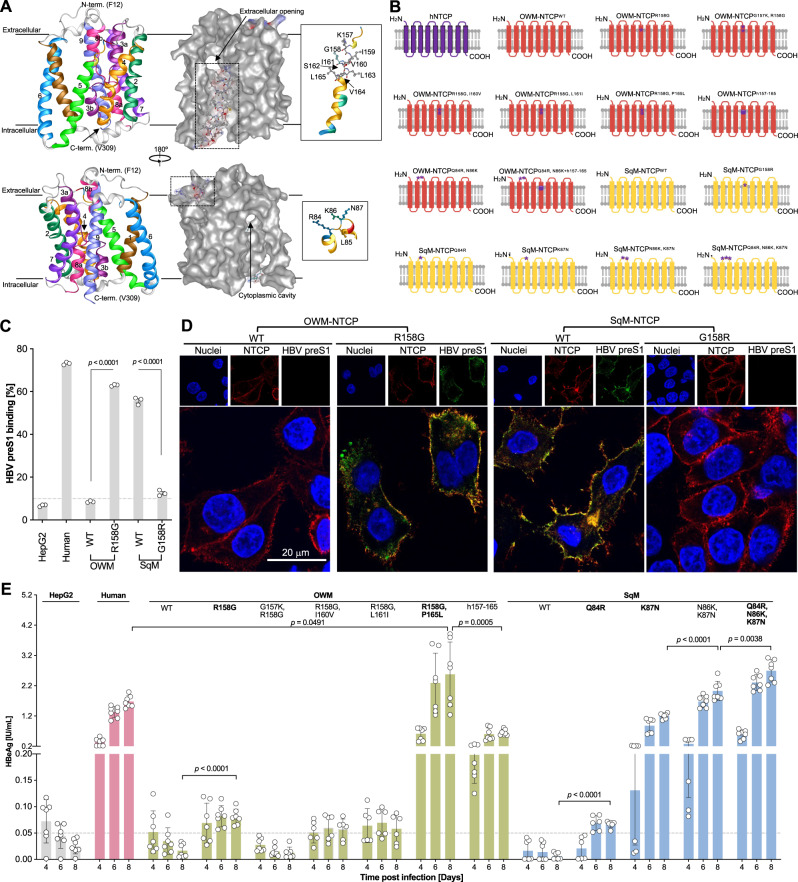
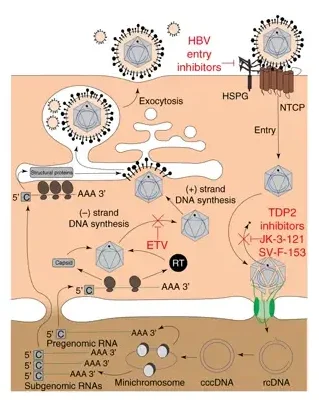
Long-term hepatitis B infection in a scalable hepatic co-culture system.
Winer, B.Y., Huang, T.S., Pludwinski, E. et al.
Hepatitis B virus causes chronic infections in 250 million people worldwide. Chronic hepatitis B virus carriers are at risk of developing fibrosis, cirrhosis, and hepatocellular carcinoma. A prophylactic vaccine exists and currently available antivirals can suppress but rarely cure chronic infections. The study of hepatitis B virus and development of curative antivirals are hampered by a scarcity of models that mimic infection in a physiologically relevant, cellular context. Here, we show that cell-culture and patient-derived hepatitis B virus can establish persistent infection for over 30 days in a self-assembling, primary hepatocyte co-culture system. Importantly, infection can be established without antiviral immune suppression, and susceptibility is not donor dependent. The platform is scalable to microwell formats, and we provide proof-of-concept for its use in testing entry inhibitors and antiviral compounds.
Additional Publications
* indicates equal first authorship
# indicates equal corresponding authorship
2025
Suppressing APOE4-induced neural pathologies by targeting the VHL-HIF axis.
Proc Natl Acad Sci USA. 2025 Feb 4; 122(5):e2417515122.
Wei I. Jiang, Yiming Cao, Yue Xue, Yichun Ji, Benjamin Y. Winer, Rashmi Chandra, Xingyuan Fischer Zhang, Mengqi Zhang, Neel S. Singhal, Jonathan T. Pierce, Song Chen, Dengke K. Ma
2024
β2 integrins impose a mechanical checkpoint on macrophage phagocytosis.
Nat Commun. 2024 Sep 18;15(1):8182.
Alexander H. Settle, Benjamin Y. Winer, Miguel M. de Jesus, Lauren Seeman, Zhaoquan Wang, Eric Chan, Yevgeniy Romin, Zhuoning Li, Matthew M. Miele, Ronald C. Hendrickson, Daan Vorselen, Justin S. A. Perry, Morgan Huse
Single-cell topographical profiling of the immune synapse reveals a biomechanical signature of cytotoxicity.
Sci Immunol. 2024 Jun 28;9(96):eadj2898.
Miguel de Jesus, Alexander H. Settle, Daan Vorselen, Thomas K. Gaetjens, Michael Galiano, Yevgeniy Romin, Esther Lee, Yung Yu Wong, Tian-Ming Fu, Endi Santosa, Benjamin Y. Winer, Fella Tamzalit , Mitchell S. Wang, Anthony Santella, Zhirong Bao, Joseph C. Sun, Pavak Shah, Julie A. Theriot, Steven M. Abel, Morgan Huse
Plasma membrane abundance dictates phagocytic capacity and functional cross-talk in myeloid cells.
Sci Immunol. 2024 Jun 7;9(96):eadl2388.
Benjamin Y. Winer#, Alexander H. Settle, Alexandrina M. Yakimov, Carlos Jeronimo, Tomi Lazarov, Murray Tipping, Michelle Saoi, Anjelique Sawh, Anna-Liisa L. Sepp, Michael Galiano, Justin S. A. Perry, Yung Yu Wong, Frederic Geissmann, Justin Cross, Ting Zhou, Lance C. Kam, H. Amalia Pasolli, Tobias Hohl, Jason G. Cyster#, Orion D. Weiner#, Morgan Huse#
Dynamic encounters with red blood cells trigger splenic marginal zone B cell retention and function.
Nat Immunol. 2024 Jan;25(1):142-154.
Dan Liu, Benjamin Y. Winer, Marissa Y. Chou, Hanson Tam, Ying Xu, Jinping An, James M. Gardner, Jason G. Cyster
2023
Persistent hepatitis B virus and HIV coinfections in dually humanized mice engrafted with human liver and immune system.
J Med Virol. 2023 Jul;95(7):e28930.
Glenn Hogan*, Benjamin Y. Winer*, James Ahodantin*, Julie Sellau, Tiffany Huang, Florian Douam, Masaya Funaki, Luis Chiriboga, Lishan Su, Alexander Ploss
Targeted viral adaptation generates a simian-tropic hepatitis B virus that infects marmoset cells.
Nat Commun. 2023 Jun 16;14(1):3582.
Yongzhen Liu, Thomas R. Cafiero, Debby Park, Abhishek Biswas, Benjamin Y. Winer, Cheul H. Cho, Yaron Bram, Vasuretha Chandar, Aoife K. O’ Connell, Hans P. Gertje, Nicholas Crossland, Robert E. Schwartz, Alexander Ploss
2022
Apoptotic contraction drives target cell release by cytotoxic T cells.
bioRxiv 2022.11.02.514865.
Elisa E. Sanchez, Maria Tello-Lafoz, Aixuan J. Guo, Miguel de Jesus, Yassmin A. Elbanna, Benjamin Y. Winer, Sadna Budhu, Eric Chan, Eric Rosiek, Taisuke Kondo, Justyn DuSold, Naomi Taylor, Gregoire Altan-Bonnet, Michael F. Olson, Morgan Huse
Mechanically active integrins target lytic secretion at the immune synapse to facilitate cellular cytotoxicity.
Nat Commun. 2022 Jun 9;13(1):3222.
Mitchell S. Wang, Yuesong Hu, Elisa E. Sanchez, Xihe Xie, Nathan H. Roy, Miguel de Jesus, Benjamin Y. Winer, Elizabeth A. Zale, Weiyang Jin, Chirag Sachar, Joanne H. Lee, Yeonsun Hong, Minsoo Kim, Lance C. Kam, Khalid Salaita, Morgan Huse
2020
Woolly Monkey-HBV Infection in Squirrel Monkeys as a Surrogate Nonhuman Primate Model of HBV Infection.
Hepatol Commun. 2020 Mar;4(3):371-386.
Christopher Y. Chen, Benjamin Y. Winer, Deborah Chavez, Bernadette Guerra, Kathleen M. Brasky, Stacey Eng, Eduardo Salas, Danny Tam, Joe H. Simmons, Christian R. Abee, William E. Delaney, Alexander Ploss, Robert E. Lanford, Christian Voitenleitner
2019
Analysis of host responses to hepatitis B and delta viral infections in a micro-scalable hepatic co-culture system.
Hepatology.2019 Jun 17.
Benjamin Y. Winer, Jenna M. Gaska, Gabriel Lipkowitz, Yaron Bram, Amit Parekh, Lance Parsons, Robert Leach, Rohit Jindal, Cheul H. Cho, Anil Shrirao, Eric Novik, Robert E. Schwartz, Alexander Ploss
2018
Selective expansion of myeloid and NK cells in humanized mice yields human-like vaccine responses.
Nat Commun. 2018 Nov 28;9(1):5031.
Florian Douam, Carly G. K. Ziegler, Gabriela Hrebikova, Bruno Fant, Robert Leach, Lance Parsons, Wei Wang, Jenna M. Gaska, Benjamin Y. Winer, Brigitte Heller, Alex K. Shalek, Alexander Ploss
Preclinical assessment of antiviral combination therapy in a genetically humanized mouse model for hepatitis delta virus infection.
Sci Transl Med. 2018 Jun 27;10(447).
Benjamin Y. Winer, Elham Shirvani-Dastgerdi, Yaron Bram, Julie Sellau, Benjamin E. Low, Heath Johnson, Tiffany Huang, Gabriela Hrebikova, Brigitte Heller, Yael Sharon, Katja Giersch, Sherif Gerges, Kathleen Seneca, Mihai-Alexandru Pais, Angela S. Frankel, Luis Chiriboga, John Cullen, Ronald G. Nahass, Marc Lutgehetmann, Jared E. Toettcher, Michael V. Wiles, Robert E. Schwartz, Alexander Ploss
2017
Selection of the highly replicative and partially multidrug resistant rtS78T HBV polymerase mutation during TDF-ETV combination therapy.
J Hepatol. 2017 Aug;67(2):246-254.
Elham Shirvani-Dastgerdi, Benjamin Y. Winer, Toni Celià-Terrassa, Yibin Kang, David Tabernero, Eray Yagmur, Francisco Rodríguez-Frías, Josep Gregori, Tom Luedde, Christian Trautwein, Alexander Ploss, Frank Tacke
Long-term hepatitis B infection in a scalable hepatic co-culture system.
Nature Communications. 2017 Jul 25;8(1):125.
Benjamin Y. Winer , Tiffany .S Huang, Eitan Pludwinski, Brigitte Heller, Felix Wojcik, Gabriel E. Lipkowitz, Amit Parekh, Cheul Cho, Anil Shrirao, Tom W. Muir, Eric Novik, Alexander Ploss
Recapitulation of treatment response patterns in a novel humanized mouse model for chronic hepatitis B virus infection.
Virology. 2017 Feb;502:63-72.
Benjamin Y. Winer, Tiffany Huang, Benjamin E. Low, Cindy Avery, Mihai-Alexandru Pais, Gabriela Hrebikova, Evelyn Siu, Luis Chiriboga, Michael V. Wiles, Alexander Ploss
2016
In vivo models of hepatitis B and C virus infection.
VFEBS Letters. 2016 Jul;590(13):1987-99.
Benjamin Y. Winer, Qiang Ding, Jenna M. Gaska, Alexander Ploss
Freeze Drying Method with Gaseous Nitrogen to Preserve Fine Ultrastructure of Biological Organizations for Scanning Electron Microscopy, Helium Ion Beam Microscopy and Fluorescence Microscopy
Microscopy and Microanalysis, Volume 22, Issue S3, 1 July 2016, Pages 1142–1143
Kunihiro Uryu, Nadine Soplop, Devrim Acehan, Benjamin Y. Winer, Vincent A. Fischetti, Timothy Sheahan, Charles M. Rice, Mayla Hsu, Melissa Robbiani, Gaetano Santulli, Hana Totary-Jain, Bernhard Goetze, Maria-Teresa Catanese
Novel Engineered Peptides of a Phage Lysin as Effective Antimicrobials against Multidrug-Resistant Acinetobacter baumannii.
Antimicrob Agents Chemother. 2016 Apr 22;60(5):2671-9.
Mya Thandar*, Rolf Lood*, Benjamin Y. Winer*, Douglas R. Deutsch, Chad W. Euler, Vincent A. Fischetti
Breaking the species barrier for hepatitis delta virus.
Hepatology. 2016 Jan;63(1):334-6.
Benjamin Y. Winer, Alexander Ploss
2015
Genetic Dissection of the Host Tropism of Human-Tropic Pathogens.
Annu Rev Genet. 2015;49:21-45.
Florian Douam, Jenna M. Gaska, Benjamin Y. Winer, Qiang Ding, Markus von Schaewen, Alexander Ploss
Determinants of hepatitis B and delta virus host tropism.
Curr Opin Virol. 2015 Aug;13:109-16.
Benjamin Y. Winer, Alexander Ploss
Novel Phage Lysin Capable of Killing the Multidrug-Resistant Gram-Negative Bacterium Acinetobacter baumannii in a Mouse Bacteremia Model.
Antimicrob Agents Chemother. 2015 Apr;59(4):1983-91.
Rolf Lood*, Benjamin Y. Winer*, Adam J. Pelzek, Roberto Diez-Martinez , Mya Thandar, Chad W. Euler, Raymond Schuch, Vincent A. Fischetti
2014
Staging Bonding between Group 12 Metal Ions and Neutral Selenium Donors: Intermolecular Interactions of Mixed N,Se Donor Ligands and Anions.
Cryst Growth Des. 2014;14(12):6497-507.
Malia S. Hain, Yoko Fukuda, Carolina Rojas Ramírez, Benjamin Y. Winer, Stephanie E. Winslow, Robert D. Pike, Deborah C. Bebout
Broadly neutralizing antibodies abrogate established hepatitis C virus infection.
Science Translational Medicine. 2014 Sep 17;6(254):254ra129.
Ype P. de Jong, Marcus Dorner, Michiel C. Mommersteeg, Jing W. Xiao, Alejandro B. Balazs, Justin B. Robbins, Benjamin Y. Winer, Sherif Gerges, Kevin Vega, Rachael N. Labitt, Bridget M. Donovan, Erick Giang, Anuradha Krishnan, Luis Chiriboga, Michael R. Charlton, Dennis R. Burton, David Baltimore, Mansun Law, Charles M. Rice, Alexander Ploss
Beyond the chromosome: the prevalence of unique extra-chromosomal bacteriophages with integrated virulence genes in pathogenic Staphylococcus aureus.
PLoS One. 2014 Jun 25;9(6):e100502
Bryan Utter, Douglas R. Deutsch, Raymond Schuch, Benjamin Y. Winer, Kathleen Verratti, Kim Bishop-Lilly, Shanmuga Sozhamannan, Vincent A. Fischetti
2013
Anthrax SET protein: a potential virulence determinant that epigenetically represses NF-κB activation in infected macrophages.
J Biol Chem. 2013 Aug 9;288(32):23458-72.
Shiraz Mujtaba*, Benjamin Y. Winer*, Anbalagan Jaganathan, Jigneshkumar Patel, Miriam Sgobba, Raymond Schuch, Yogesh K. Gupta, Shozeb Haider, Rong Wang, Vincent A. Fischetti
Use of a bacteriophage lysin to identify a novel target for antimicrobial development.
PLoS One. 2013 Apr 10;8(4):e60754.
Raymond Schuch, Adam J. Pelzek, Assaf Raz, Chad W. Euler, Patricia A. Ryan, Benjamin Y. Winer, Andrew Farnsworth, Shyam S. Bhaskaran, C. Erec Stebbins, Yong Xu, Adrienne Clifford, David J. Bearss, Hariprasad Vankayalapati, Allan R. Goldberg, Vincent A. Fischetti
2012
Synthesis of bis(2-pyridylmethyl)selenide and solid-state structural characterization of bis-tridentate zinc triad perchlorate chelates.
Polyhedron 48(1):125 (2012).
Benjamin Y. Winer, Steven M. Berry, Robert D. Pike, Deborah C. Bebout
2011
Chemical reactivity of Synechococcus sp. PCC 7002 and Synechocystis sp. PCC 6803 hemoglobins: covalent heme attachment and bishistidine coordination.
J Biol Inorg Chem. 2011 Apr;16(4):539-52.
Henry J. Nothnagel, Matthew R. Preimesberger, Matthew P. Pond, Benjamin Y. Winer, Emily M. Adney & Juliette T. J. Lecomte
Structural properties of 2/2 hemoglobins: the group III protein from Helicobacter hepaticus.
IUBMB Life. 2011 Mar;63(3):197-205.
Henry J. Nothnagel, Benjamin Y. Winer, David A. Vuletich, Matthew P. Pond, Juliette T. J. Lecomte